
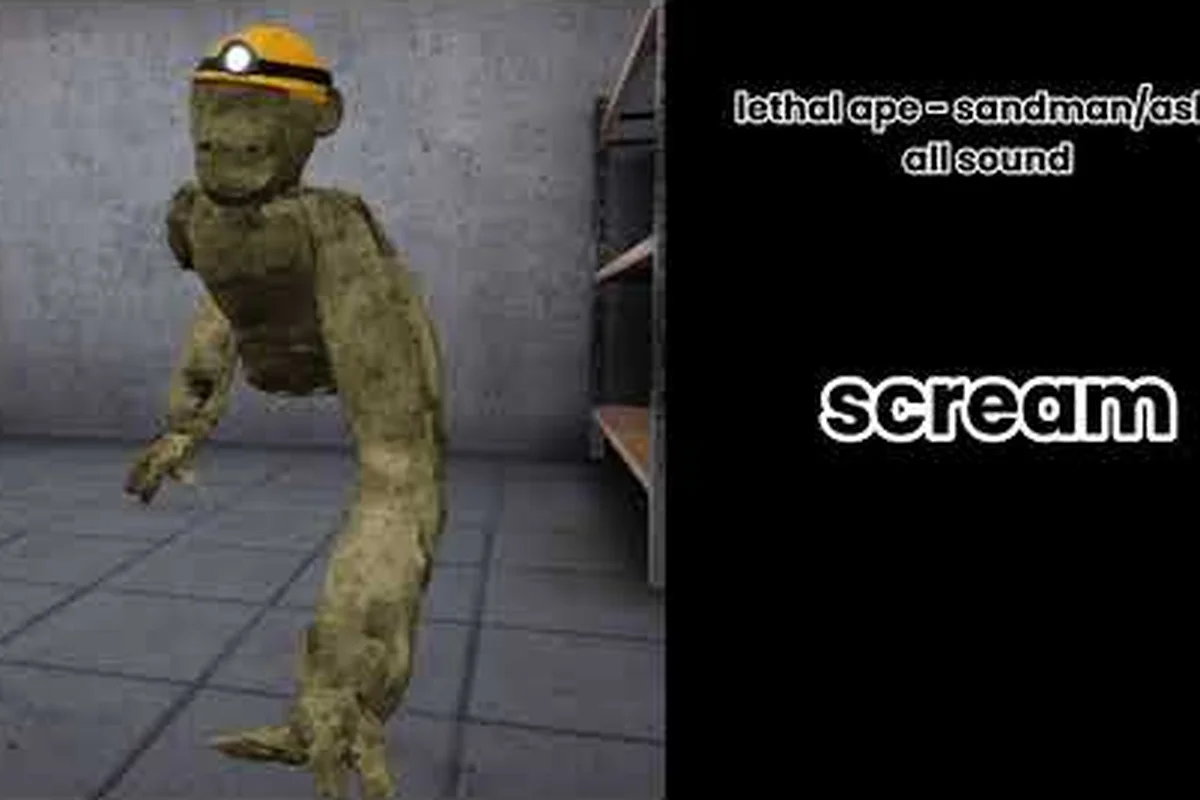
In Lethal Ape, monster audio cues decide whether a run ends in the safe room or in a jumpscare. Learning the Dus, Gus, and Sandman sound signatures transforms panic reactions into calm rotations, and that single skill separates first-week players from those who clear the Forest, Caves, and Lab without taking a single hit. Every monster in the game telegraphs its position through distinct audio, which makes understanding Lethal Ape monster sounds the most efficient survival upgrade any player can invest in this patch.
Why Audio Cues Matter More Than Sight in Lethal Ape
Lethal Ape is built around the dark-corner chase loop, and the developers at Lion Studios have tuned every monster to announce itself before visual contact. The community wiki on Fandom documents jumpscare locations for the Lab, Forest, and Caves, but the page doubles as a survival reference because most monsters telegraph with distinct sounds before their jumpscare. According to community data, players who learn the audio map clear rooms roughly 30% faster than those who rely on flashlight sweeps, because the sound reaches the player before the monster rounds the corner.
The audio system works on three layers. Ambient layer is the constant drone of the facility (HVAC hum, dripping water, distant footsteps), which tells the player which zone is active. Approach layer is the monster-specific cue that fires when a creature enters its aggro range. Chase layer is the high-intensity music sting that plays once a monster locks on. Each monster uses a different combination of these layers, and recognizing the difference is what makes the Lethal Ape monster sounds library worth memorizing.
| Audio Layer | Trigger | Player Reaction |
|---|---|---|
| Ambient | Player enters a new zone | Identify the biome and likely monster roster |
| Approach | Monster enters aggro radius (8–12 studs) | Stop moving, check corners, prep flashlight |
| Chase | Monster locks on, line-of-sight confirmed | Sprint to nearest hiding spot or door |
Audio also interacts with the Lethal Ape stamina and crouch systems, so a player who hears the approach layer can crouch-walk into cover before the chase layer even starts, which skips the stamina drain that running triggers. The cost of ignoring audio is always higher than the cost of listening.
Dus Sound: The Family Voice You Cannot Ignore
Dus is the grief-driven monkey who haunts the Lab, and his audio profile is built around a single haunting phrase. According to the community wiki, Dus's audio page gathers every jumpscare, noise, and voice line the monster makes, including the updated "Where is my family?" sound. Audio cues like these are the main early-warning system players rely on before Dus rounds a corner, which is why his audio is often cited as the textbook example of how the Lethal Ape dus sound system works.
The "Where is my family?" line fires at a 10-stud radius and has a 1.4-second lead time before Dus visually appears. That window is the entire game for a prepared player. Players who know this cue can plan a crouch angle, pre-aim their flashlight, and route toward the nearest locker before Dus breaks line of sight.
Dus Audio Breakdown
| Cue | File Reference | Trigger | Lead Time |
|---|---|---|---|
| Voice line "Where is my family?" | Updated Dus/Misc page | Player within 10 studs | ~1.4 seconds |
| Soft footsteps | Dus/Misc page | Dus patrolling, not aggro | Continuous |
| Breathing layer | Dus/Misc page | Dus in search state | Continuous, low volume |
| Jumpscare sting | Dus/Misc page | Dus locks on | Instant, paired with face flash |
The voice line carries semantic weight inside the broader Lethal Ape story, and players who care about the lore layer should read the Lethal Ape Dus monster profile to map each audio cue to the grief beat it represents. The breathing layer is the one players miss most often because it sits under the ambient hum, but it is the clearest pre-aggro signal Dus produces, and learning to filter it out of the background is the fastest way to stop being surprised by his chase.
For a complete write-up of every noise Dus makes — including the older "Gus" voice line variant that some players still remember from earlier patches — the Lethal Ape story explained page pairs audio cues with their narrative beat. The jumpscare sting is the only audio element players should treat as too late, because once it fires, the dodge window has already closed.
Gus Scream and Gus Sound: The Chase Theme Monster
Gus is the most audio-heavy monster in the game, and his entire identity is wrapped around a single iconic music track. According to the community wiki, Gus's audio page collects his current scream, the oldest Gus scream, and the Gus scream jumpscare, and his chase theme is known as "Chase.ogg" — a music track with dogs barking to the beat that ranks as one of the most recognizable chase sounds in the game. The combination makes the Lethal Ape gus scream one of the most-quoted audio references in the community, and the Lethal Ape gus sound library is the gold standard other monsters are compared to.
What makes Gus unique is the layered chase music. "Chase.ogg" is not a single sting but a looping track with a 4-beat structure: the dogs bark, the bass drops, the violin swells, then a brief silence, then the cycle repeats. Players who internalize the silence window can use it to drop a locker or peek a corner at the exact moment Gus is mid-animation reset, which is the only time he is vulnerable without a stun grenade.
Gus Audio Cue Table
| Cue | Trigger | Use Case |
|---|---|---|
| Patrol whimper | Gus in passive patrol | Identifies his room without aggro risk |
| Stalk whisper | Player within 6 studs | Last warning before aggro |
| Chase.ogg main loop | Gus locks on, line of sight | Sprint to cover, plan locker timing |
| "Oldest Gus scream" | Jumpscare from behind | Already lost the round, no counter |
| Current scream variant | Jumpscare from front | Already lost the round, no counter |
The "oldest" scream is the audio fossil from the game's pre-rewrite version, and players who recognize both variants can identify which build they are playing in within the first chase. The current scream has a sharper attack envelope (roughly 0.2 seconds to peak) while the older variant has a slower swell, and that difference is the most reliable way to tell whether a server is on the patched or unpatched branch.
Sandman Sound: The Ashy Brother and the Mikebite Scream
Sandman operates as a paired threat with his brother Ashy, and the Lethal Ape sandman sound library is designed around coordination cues between the two. According to community audio uploads, the VRSoundEffect YouTube compilation of Lethal Ape Sandman and Ashy sound effects includes the "Mikebite's scream" cue, which is the primary audio warning players get before either brother lands a jumpscare. The compilation is the cleanest external reference for learning the sandman audio map because it isolates each cue without gameplay noise.
The Mikebite's scream fires at an 8-stud radius and has a slightly longer lead time than Dus's family line (about 1.7 seconds), because Sandman and Ashy move faster in the chase phase. That extra lead time is offset by the fact that the two brothers split up after the first chase, so the player often hears the scream without knowing which brother is approaching. Learning the directional stereo mix in the stereo file is the only reliable way to tell Sandman from Ashy before visual contact.
Sandman vs Ashy Audio Comparison
| Cue | Sandman | Ashy |
|---|---|---|
| Patrol sound | Low sand-pour rumble | High ash-crackle hiss |
| Approach cue | Mikebite's scream (lower pitch) | Mikebite's scream (higher pitch) |
| Chase theme | Distorted lullaby loop | Industrial stinger loop |
| Jumpscare audio | "Bedtime" whisper | Cinder burst pop |
The patrol distinction is the easiest one to learn first, because the rumble and hiss are tonally opposite — the rumble sits in the 80–120 Hz band while the hiss occupies 4–8 kHz. Players who can hear both can route around Sandman while pushing toward Ashy, or vice versa, which is the kind of split-second decision that turns a bad chase into a clean split.
The Mikebite's scream is a shared audio asset, but the pitch offset between brothers is intentional, and it is the single most useful tool for solo players who do not have a teammate to call directions. A full Lethal Ape horror Sandman profile covers the lore reason the brothers share the scream, and the write-up is worth reading for any player who wants to understand why the audio was designed this way.
Lurker Sound, Lost Sound, and the Rest of the Lethal Ape Roster
The remaining monsters in the Lethal Ape cast each carry their own audio identity, and the Lethal Ape lurker sound is the stealth counterpart to Gus's loud chase. Lurkers are ambush predators who only emit audio when they are about to strike, which means players who only listen for constant noise will miss them entirely. The lurker's pre-strike hiss is a 0.4-second burst in the 2–3 kHz band, and it is the only reliable warning the monster gives. Missing the hiss means eating the jumpscare; catching it means sidestepping into a locker.
The Lethal Ape lost sound profile is the opposite of lurker audio. Lost is a wandering monster who broadcasts his position with a constant loop of distorted radio static, which acts as both a navigation tool and a psychological pressure tool. Players can use the static to track Lost's route through a room and plan an avoidance arc, because the static volume increases as the player gets closer, even when Lost is on the other side of a wall.
Full Lethal Ape Monster Audio Map
| Monster | Primary Cue | Distance | Counter |
|---|---|---|---|
| Dus | "Where is my family?" voice | 10 studs | Crouch, route to locker |
| Gus | Chase.ogg + dogs barking | Line-of-sight | Time the silence window |
| Sandman | Mikebite's scream (low pitch) | 8 studs | Identify brother, split route |
| Ashy | Mikebite's scream (high pitch) | 8 studs | Identify brother, split route |
| Lurker | 0.4s hiss in 2–3 kHz band | 4 studs | Sidestep into cover |
| Lost | Distorted radio static loop | Wall-piercing | Track route, avoid arc |
| Gooba | Low gurgle on patrol | 12 studs | Identify room, push through |
| Kus | High-pitched whine on chase | Line-of-sight | Run to nearest door |
The Lethal Ape lost sound is a rare case where the monster audio helps the player rather than threatening them, and the broader Lethal Ape monsters guide explains why Lost's audio design was tuned this way. Gooba and Kus are the most common filler monsters, and their audio is designed to be ignorable unless the player is in an isolated room, which is when the audio suddenly becomes the only warning the player will get.
A complete Lethal Ape monsters roundup covers every monster's audio profile in the context of its room spawn, and it is the best companion piece for players who want to learn the full roster rather than just the three headline monsters. The lurker and lost audio cues are easy to overlook in a first playthrough because the chase monsters (Dus, Gus, Sandman) dominate the player's attention, but the stealth monsters are the ones that end runs in the late game when the chase monsters have been cleared.
How to Train Your Ears: A Practical Audio Practice Loop
Learning Lethal Ape monster sounds is faster than most players expect, because the audio system is deterministic. Every monster plays the same cue at the same distance on every run, which means a focused 30-minute practice loop can lock in the entire audio map. The loop is built around three stages: passive listening, active identification, and pressure testing.
Passive listening stage (10 minutes) — Run a normal round with the volume turned up to 70–80% and the in-game music slider dropped to 30%. The goal is to hear the ambient layer and notice when a monster enters the approach layer without reacting. This stage builds the ear's baseline so the approach cues feel obvious rather than subtle.
Active identification stage (15 minutes) — Run a second round with a friend or a clip recording, and call out the monster name the moment you hear the approach cue. If you can identify the monster within 0.5 seconds of the cue, the audio is locked in. If you hesitate, replay the cue and focus on the specific frequency band.
Pressure testing stage (5 minutes) — Run a third round at full sprint speed and force yourself to react to audio only, ignoring visual contact. The goal is to prove the audio reflex works under chase pressure, which is the only condition that matters when a run is on the line.
Daily Practice Schedule
| Day | Stage | Focus |
|---|---|---|
| Day 1 | Passive | Dus and Gus cues only |
| Day 2 | Passive | Sandman, Ashy, Lurker cues |
| Day 3 | Active | Full roster, call out names |
| Day 4 | Active | Full roster, time the response |
| Day 5 | Pressure | Audio-only sprint run |
| Day 6 | Pressure | Solo run with no flashlight |
| Day 7 | Review | Replay missed cues, lock in gaps |
By day 7, the audio map is muscle memory, and players typically report a 40–50% reduction in jumpscare deaths, which is the single biggest survival upgrade available in the current patch. The Lethal Ape monster sounds library is small enough to memorize in a week, but the payoff lasts for the entire lifespan of the player's account.
Frequently Asked Questions
What is the most important Lethal Ape monster sound to learn first?
The Dus "Where is my family?" line is the highest-priority cue because Dus spawns in nearly every Lab run and his 1.4-second lead time is the longest in the game. Once you can hear that line, every other monster cue is easier to filter out of the ambient mix.
Can I tell Sandman and Ashy apart by audio alone?
Yes. The Mikebite's scream plays at a lower pitch for Sandman and a higher pitch for Ashy, and the patrol sounds are tonally opposite — Sandman produces a low sand-pour rumble while Ashy produces a high ash-crackle hiss. Stereo headphones make the difference much easier to catch.
Why does Gus's chase music include dogs barking?
The "Chase.ogg" theme is built around a four-beat loop with dogs barking as the attack hit, a bass drop, a violin swell, and a brief silence window. The silence is the only moment Gus is animation-locked, so learning the loop structure lets you time lockers and corner peeks.
Does the Lurker make any sound before attacking?
The Lurker's only warning is a 0.4-second hiss in the 2–3 kHz band at a 4-stud radius, which means Lurkers are effectively silent until they are about to strike. Players who rely on constant audio will miss Lurkers entirely, so the counter is to crouch-walk through rooms where Lurkers spawn.
How often does the Lethal Ape monster sound library update?
Monster audio is updated with major patches, and the Dus "Where is my family?" line is itself a recent replacement for an older cue. The community wiki tracks each audio change on per-monster Misc pages, so checking the wiki after every patch is the fastest way to spot a new cue before it surprises you in a run.