
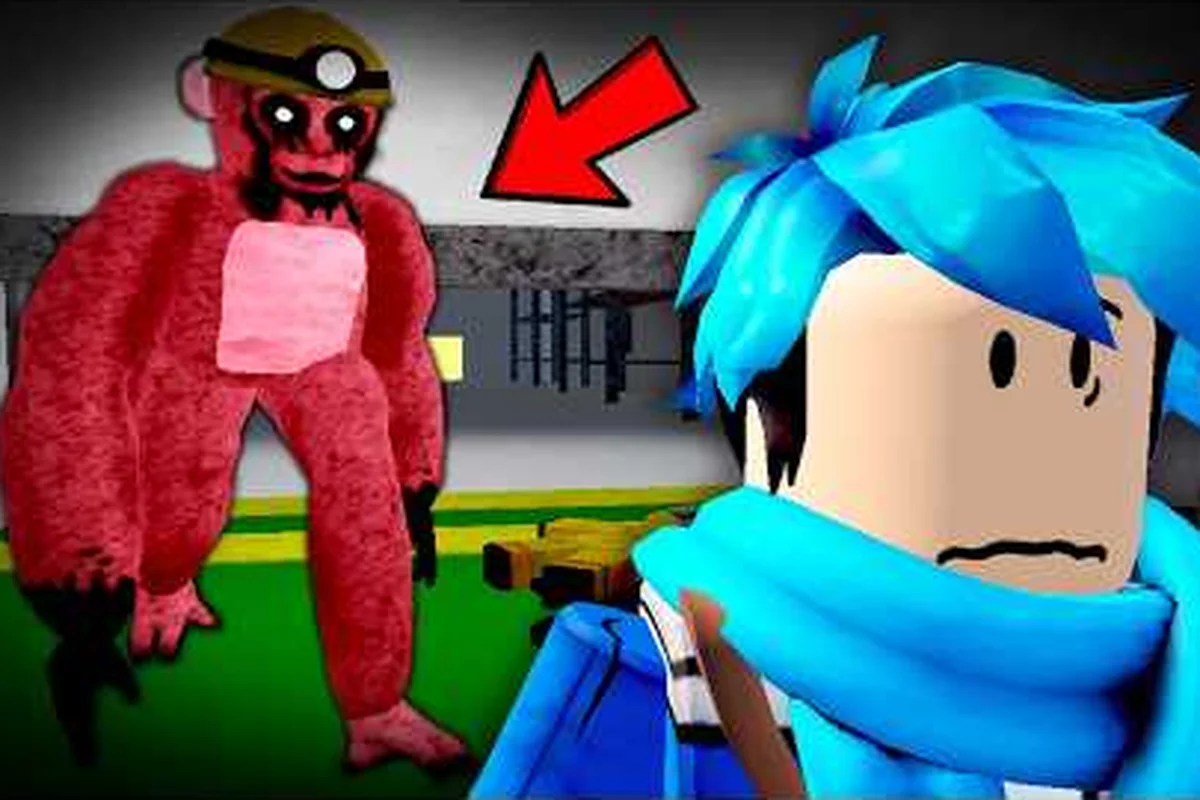
Lethal Ape is one of those Roblox experiences where the chase is only half the fun. Hidden behind every door, vent, and flickering hallway light is a piece of the lethal ape story explained through monster bios, environmental clues, and cutscene fragments that most players walk right past. The deeper lore — a ruined laboratory, a corrupt worker's revenge, and a roster of mutants that are far more tragic than they are scary — turns a simple horror chase into a layered mystery that the community has been piecing together since the Roblox remake launched in November 2023.
Origins: From VR Prototype to Roblox Remake
The Lethal Ape franchise started as a VR project by StellaDev (also credited as Xeva on community wikis), well before it became the Roblox remake players know today. That early build is where the skeleton of the lethal ape lore explained today was first laid down: an isolated research facility, test subjects who did not survive, and a single researcher whose conscience broke after the first failed experiment. According to the Lethal Ape community wiki, the VR original established the core setting and the names of several monsters that would later be re-imagined for the Roblox audience.
The Roblox version of Lethal Ape was developed by gub_dev and went live on November 10, 2023, per the same community-maintained wiki. From the very first public build, the developer leaned into the franchise's grim tone — long dark corridors, ambient sirens, abandoned medical equipment, and patrol routes that punish careless movement. Most players who jump in for a quick match never realize that the lab they are running through is a deliberate callback to the VR original's research wing. The remake kept the location, the chase mechanics, and the cast of monsters, but expanded the roster from a handful of pursuers to over sixteen named entities, each with their own backstory stitched into the environment.
The Setting That Frames the Story
Every run in Lethal Ape takes place in or around a single decaying research complex — a half-clean laboratory built over older industrial tunnels. The Laboratory Zone acts as the spawn hub, while deeper areas branch into storage wings, cold-storage lockers, and a sealed sub-level that most players only glimpse when a monster drags them there. The facility's design is the strongest narrative signal in the entire game: posters about "Subject Safety Protocols" hang next to scorch marks, and the PA system occasionally crackles with old safety briefings that mention subjects by code name rather than monster name.
This setting is also where the official Lethal Ape Roblox experience page frames the player's role — you are not a hero, you are a new arrival, and the lab has already lost control. The premise is what makes the lethal ape story explained piece by piece so effective: the game never once breaks to tell you the plot. It lets you overhear it, piece it together, and run for your life in the meantime.
| Era | Developer | Platform | Role in Lore |
|---|---|---|---|
| VR Original | StellaDev / Xeva | Standalone VR | Established lab setting and core monster names |
| Roblox Remake | gub_dev | Roblox | Expanded roster, added backstory beats, launched 2023-11-10 |
| Ongoing Updates | gub_dev + community | Roblox | Added Bloodman, Scar, Noxar, and post-2024 monster variants |
The Laboratory Incident: What Really Happened
The backbone of the lethal ape lore explained across community wikis and creator videos is a single catastrophic event known among fans as the Laboratory Incident. The official monster roster on the Roblox Lethal Ape wiki's Monsters page describes the lab's former owner as a figure who was "infected and mutated after a corrupt worker's experiment" and who "took revenge" on the facility. That single line is the seed the entire story grows from.
According to the wiki, a senior researcher at the lab crossed a line that the rest of the staff refused to follow. Experiments that were supposed to be about medical advancement were quietly rerouted into something else — a program that exposed human subjects to a corrosive compound the staff called internally "the goo." The first subject to survive the exposure mutated into a creature the community now knows as Scar. A second subject, exposed during a botched clean-up, became the aggressive pursuer later catalogued as Bloodman. As more subjects reacted to the goo, the lab stopped being a research site and started being a containment site, and containment slowly failed.
By the time external contractors arrived, the lab had already sealed its own sub-levels, killed its own communications, and trapped its own staff inside. The "corrupt worker" referenced in the wiki is widely read by the community as the catalyst — not a monster, but a person who made a choice, and whose choice is what the rest of the roster pays for. The lethal ape story explained cleanly through that lens: every monster in the game is either a victim, a perpetrator, or a failed attempt to clean up after one.
Timeline of the Incident
While the game itself never shows a full timeline, the community has reconstructed one from environmental logs, dead-end voicelines, and the order in which monsters were patched into the Roblox remake. The following table is a community-reconstructed chronology, marked as such because the in-game logs are fragmented:
| Order | Event | Key Figure | Lore Effect |
|---|---|---|---|
| 1 | Senior researcher greenlights exposure program | Unnamed Director | Sets the moral failure in motion |
| 2 | First successful mutation: Scar | Unknown subject | Proves the goo is survivable — and dangerous |
| 3 | Clean-up attempt backfires: Bloodman emerges | Lab staff | Containment begins to fail |
| 4 | Lab seals its own sub-levels | Director + remaining staff | Facility becomes a closed system |
| 5 | External contractors arrive and vanish | New arrivals (player stand-ins) | Explains why new "test subjects" keep showing up |
| 6 | Remake-era monsters appear: Dus, Gus, Sandman | Mixed | Lore expands to include post-incident mutations |
Dus, Gus, and Sandman: The Three Faces of the Story
The heart of any lethal ape story explained article is the trio that most players will actually meet in a single match: Dus, Gus, and Sandman. Each one represents a different chapter of the lab's collapse, and each one has been pieced together from monster bios, voice lines, and the Crano Plus monster overview video, which catalogs lore timecodes for all sixteen named entities.
Dus: The Cleanup That Never Ended
The lethal ape dus story is the simplest of the three, and that simplicity is what makes it hit so hard. Dus is widely read by the community as a former member of the lab's containment crew — a worker who volunteered for the goo-exposure program because they believed it would let them survive the inevitable breach. The mutation was successful, but it also erased the worker's higher reasoning. Dus now patrols the lab on the same routes they once used to clean up after failed experiments, except now they are one of the experiments.
The lethal ape dus lore is built around the idea of duty without comprehension. Dus is not malicious — they are still doing their job, they simply no longer understand what the job is. Community data on the Fandom wiki describes Dus as a mid-tier pursuer with high aggression but limited pathing, which fits the lore read: a worker who follows old checklists even when the building is falling apart. For a full breakdown of Dus's patrol routes, sound cues, and the player audio that signals a Dus chase, the dedicated Lethal Ape Dus monster page goes much deeper than the bios allow here.
Gus: The Family That Got Away
The lethal ape gus story is the most emotionally loaded thread in the entire game. According to community bios, Gus was not a lab worker at all — he was the child of one. The researcher who first proposed the goo-exposure program did so, in part, because they believed it could cure a degenerative condition Gus had been born with. When the program failed, Gus was one of the first subjects exposed, and one of the few to survive the exposure in a stable form.
The lethal ape gus lore is built around that tragedy. Gus still recognizes parts of the lab — the break room, certain hallways, the toy that the wiki mentions in passing — and his patrol pattern loops back to those areas in a way that other monsters' patterns do not. The community reads this as Gus searching for a parent who is long gone. Voice lines that some players have datamined suggest Gus speaks in fragments of the parent's name rather than in roars or grunts, which is why his audio is so distinctive: the Gus scream and sound catalog is one of the most referenced audio resources in the community.
Sandman: The Corrupt Worker, Returned
The lethal ape sandman story is the twist that reframes the entire lab. The wiki's Monsters page describes a creature that was "rebuilt after an evil scientist threw goo in his face" — a phrase the community has interpreted in two ways. The first reading is that Sandman was a victim who was forcibly exposed. The second reading, which has gained ground on community theory threads, is that Sandman is the corrupt worker referenced in the Laboratory Incident entry: the same person who greenlit the program, who was then caught in their own experiment, and who survived it.
The lethal ape sandman lore, on that reading, is the story of a perpetrator coming back. Sandman is now the most aggressive pursuer in the lab, with the longest chase timers and the most punishing patrol routes. Where Dus is dutiful and Gus is searching, Sandman is hunting. The community has also noted that Sandman's spawn areas cluster around the locations the original incident logs describe as decision rooms — director offices, sealed storage, the conference wing that newer players sometimes walk right past. For the deep dive on Sandman's oldest variants and his relationship to the "Ashy" creature, the Lethal Ape Sandman and Ashy lore entry is the cleanest community summary.
| Monster | Lore Role | Key Trait | Community Interpretation |
|---|---|---|---|
| Dus | Former containment worker | Looping patrol | Doing a job they no longer understand |
| Gus | Child of the lead researcher | Emotional audio, fixed patrol loop | Searching for a parent |
| Sandman | Corrupt worker or forced subject | Longest chases, highest aggression | The lab's perpetrator, returned |
Monsters Beyond the Core Trio
The lethal ape story explained through Dus, Gus, and Sandman is the spine, but the full roster is what turns the spine into a body. The Monsters wiki page lists Sandman, Ashy, Dus, Lost, Kus, and Scar as the headline roster, but the Roblox remake has expanded that list significantly over multiple updates. According to the same wiki entry, the "Laboratory's former owner" is among the most dangerous chases in the game, "exceptionally violent," and reads as the single best boss-tier encounter the remake has produced so far.
Lost, Ashy, and the "Rebuilt" Monsters
The community's Lethal Ape community theory page describes one of the most-read fan origin stories: Kus allegedly fell into radioactive nuclear waste barrels before the game's events, and a separate monster was "rebuilt after an evil scientist threw goo in his face." Both theories are marked on the wiki itself as may-be-right-or-wrong, which is the standard community wiki disclaimer.
The Lost monster is read as a researcher who escaped the lab only to be recaptured by something else — possibly the goo compound's airborne form. Ashy, by contrast, reads as a partial success: a subject who was exposed and partially stabilized, but whose exposure left behind a heat signature that the game uses as an audio cue. The community has logged dozens of variants for both, including "Bloody Ashy" and "Oldest Sandman," which are covered in more detail in the Lethal Ape horror Sandman and Ashy lore page.
The 2024 Roster Expansion
The Roblox remake's most recent updates have added several monsters that the community refers to collectively as the 2024 Roster Expansion, including Bloodman, Scar, Noxar, and Lurker. These monsters slot into the same Laboratory Incident timeline, but with later dates and more violent behavior. The community-cited Flush video on the "truth about Roblox Lethal Ape" has the highest single-video view count in the community (around 689K) and treats these later monsters as evidence that the lab's goo compound is still active — a reading the wiki supports with the "exceptionally violent" language used in the former-owner entry.
For a clean overview of how the expanded roster behaves, how often each monster spawns, and which chases are the deadliest by community testing, the Lethal Ape monsters guide covering Lost, Gus, Sandman and the rest of the roster is the most complete community resource currently available.
| Monster | Era | Lore Hook | Approx. Spawn Frequency (community-tested) |
|---|---|---|---|
| Dus | Original | Former containment worker | High |
| Gus | Original | Child of lead researcher | Medium |
| Sandman | Original | Corrupt worker, returned | High |
| Ashy | Original | Partial goo stabilization | Medium |
| Lost | Original | Escaped researcher | Medium |
| Scar | Expansion | First successful mutation | Low |
| Bloodman | Expansion | Failed clean-up | Low |
| Noxar | Expansion | Post-2024 addition | Rare |
| Lurker | Expansion | Post-2024 addition | Rare |
Community Theories vs. Confirmed Lore
A lethal ape lore explained breakdown has to be honest about the gap between confirmed in-game facts and community reconstructions. The game itself does not ship with a codex, a cinematic, or a dialogue-heavy story mode. Almost every piece of the timeline above comes from one of three sources: the Fandom community wikis, creator videos that catalog the monster roster with timecodes, and player datamining of audio files.
The wiki's own Community Theory's page is unusually transparent about this: it presents fan origin stories side by side, and explicitly warns that "these theories may be right or wrong." That disclaimer is doing real work. The Kus-fell-into-nuclear-waste theory is the most-read, but it has never been confirmed by the developer. The Sandman-as-corrupt-worker reading is widely accepted, but it is also an inference, not a stated fact. The lethal ape lore explained community has been careful to mark which claims come from in-game logs, which come from bios, and which come from environmental storytelling.
The dark side of that gap is the spread of fan myths that get repeated as fact. The "Lethal Ape is connected to Ape Law" theory, the "the lab was a front for a government program" theory, and a handful of creepypasta-style readings have all circulated on community Discords without sourcing. None of those appear in either of the two community wikis, and none of them line up with the in-game logs the wiki references. For a tighter breakdown of the myths the community has actually debunked, the Lethal Ape dark truth and secret story page goes through each of the major claims one by one.
| Source | Type | Reliability | Use Case |
|---|---|---|---|
| Fandom community wikis | Crowd-maintained | High for bios, medium for theories | Baseline lore |
| Creator videos (Crano, Flush) | Timecoded monster overviews | High for what monsters exist, medium for why | Roster reference |
| Player datamining of audio | Raw files | High for what is in the files, low for what it means | Audio cues only |
| Discord theories | Community discussion | Low unless cross-referenced | Skip in serious writing |
Reading the Finale Through Community Eyes Canon
The lethal ape story explained through its monsters has a near-end, but the game's "true ending" is a community construct, not an in-game cinematic. There is no credits sequence that wraps up the Laboratory Incident. What the community has instead is a cluster of audio fragments, a final sub-level that most players reach only by being dragged there, and a series of environmental cues that read as a closure beat.
The most widely accepted reading is that the lab's goo compound is still active, and that the monsters the player meets are still mutating. The roster expansion through 2024 — Bloodman, Scar, Noxar, Lurker — is read as evidence that the containment never recovered, and that the player's role as a new arrival is to be the next data point. On that reading, the "true ending" is not a moment of victory but a moment of recognition: the player understands what the lab is, what the monsters are, and what they are about to become.
The second reading, less common but present in community discussions, is that the true ending is the Sandman ending — the moment when the player realizes that the worst pursuer in the game is the same person who started all of this. The community's shorthand for that realization is "the Sandman twist," and it is the single most-referenced community conclusion in the lore threads. Both readings are marked as community reads, not developer confirmations, because the developer has not publicly commented on either.
What both readings agree on is that the lethal ape story explained through Dus, Gus, and Sandman is a tragedy, not a survival narrative. The lab was not overrun by something from outside. It was destroyed by something the people inside it chose to make. That is the through-line, and it is the reason the community keeps coming back to the same wiki pages, the same creator videos, and the same handful of audio fragments — because the lab's story is the kind that rewards close attention, and the Roblox remake is dense enough that close attention is actually possible.
Frequently Asked Questions
What is the Lethal Ape story in short?
The lethal ape story explained in a single paragraph is a tragedy about a research lab whose staff ran an illegal exposure program on human subjects, which produced a roster of mutants — Scar, Bloodman, Dus, Gus, Sandman, and others — that now patrol the very facility they were made in, with the player arriving as a new test subject rather than a hero.
Who is Dus in the Lethal Ape lore?
The lethal ape dus lore reads Dus as a former containment worker who volunteered for the goo-exposure program to survive an inevitable breach, and who now patrols the lab on the same routes they once used for clean-up, but without the higher reasoning to understand what they are doing anymore.
What is Gus's backstory in Lethal Ape?
The lethal ape gus story is the most tragic thread in the game: Gus was the child of the lead researcher, exposed to the goo compound as part of a failed attempt to cure a degenerative condition, and now loops through the lab searching for a parent who is long gone, which is why his audio is so distinct from the other monsters.
Is Sandman the corrupt worker who caused the incident?
The lethal ape sandman story has two competing reads: the first treats him as a victim forcibly exposed during a clean-up, the second — which has gained ground in community theory threads — treats him as the corrupt worker himself, who was caught in their own experiment and survived, and who now hunts the lab as the most aggressive pursuer in the game.
Does Lethal Ape have a true ending?
There is no in-game cinematic for a true ending, so the community has constructed one from audio fragments and the sub-level environment: the most widely accepted read is that the lab's goo compound is still active and the player is the next data point, with a second reading that treats the realization of who Sandman is as the canonical "Sandman ending."