
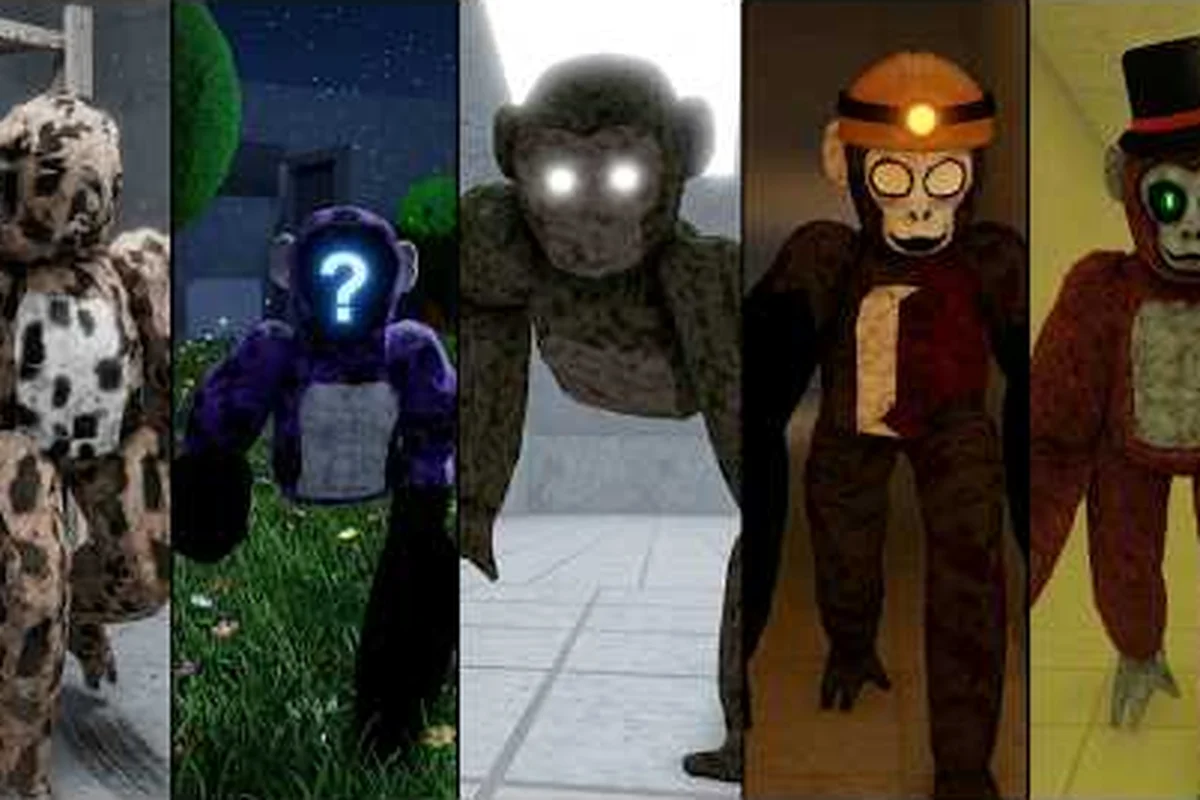
Lethal Ape Dus is one of the most recognizable monsters in the Lethal Ape roster, and his lore plus Finerooms reward make him a priority encounter for completionists. Among the 13 monsters currently tracked by community data, Dus stands out because killing him unlocks a secret room and a near-mythical badge.
The 13-year-old backstory is what hooks most players. Dus is described in the Dus origin lore breakdown as a boy who found a hole, was run over by a van, survived, and was later adopted by a scientist — one of the darkest origin stories attached to any monster in the game. That grim foundation turns him into both a narrative anchor and a mechanical gateway, because the kill that ends his chase is the same kill that pushes players into the secret Finerooms layer.
Lethal Ape Dus Lore and Backstory
Dus is a 13-year-old in the community canon, and that single detail shapes how players interpret everything he does. Adult monsters like Ashy, Gus, or Lurker feel like predators, but Dus feels like a victim who became something worse after his encounter. Community wiki data describes him as a boy who found a hole, was struck by a van, and was then adopted by a scientist who rebuilt him into a Lethal Ape monster. That reconstruction angle is what separates Dus from the more feral entries on the roster, including Lost, Gooba, and Kus.
The scientist-adoption angle also ties Dus into a wider web of origin stories. On the Roblox Lethal Ape community theories page, fans speculate that Kus fell into radioactive nuclear waste barrels, while other monsters were rebuilt after exposure to chemical goo. Dus fits the rebuilt-by-a-scientist archetype, which is why his sound design feels more deliberate than the pure feral roars used by Gooba or Lurker. Players who want the full narrative context can cross-reference the broader Lethal Ape lore explained guide for how the scientist network connects Dus, Gus, and the Sandman.
Dus at a Glance
| Attribute | Detail |
|---|---|
| Canonical age | 13 years old |
| Origin | Found a hole → struck by a van → adopted by a scientist |
| Archetype | Rebuilt child, vocal predator |
| Primary reward | Unlocks the "Fine?"-Rooms |
| Badge | "Are you Fine?" (rare) |
| Distinctive audio | "Where is my family?" voice line |
| Roster neighbors | Lost, Gus, Ashy, Lurker, Gooba, Kus |
The table shows why Dus reads differently from the other monsters. Lost and Gooba feel like raw hazards, Ashy and Lurker feel like environmental threats, and Gus feels like the scientist-network boss figure. Dus is the only roster entry who is canonically a child victim rebuilt into a monster, and that framing is what makes his encounter feel heavy even before the Finerooms reward lands.
How Dus Compares to the Other Roster Monsters
| Monster | Archetype | Lore Hook | Distinctive Feature |
|---|---|---|---|
| Dus | Rebuilt child | Van accident, adopted by a scientist | Finerooms unlock on death |
| Lost | Wandering entity | Disappearance, looping audio | Voice line repeats on loop |
| Gus | Scientist-network boss | Family connection to Dus | Loud scream warnings |
| Ashy | Hazard-type | Ash-covered environment threat | Burns status on contact |
| Lurker | Stealth-type | Hides in vents and corners | Quiet footstep audio |
| Gooba | Goo-origin | Rebuilt from chemical goo | Goo trail on the floor |
| Kus | Radiation-origin | Fell into nuclear barrels | Glowing visual effect |
Dus is the only monster in this comparison whose encounter converts directly into a hidden-room unlock. Lost, Gus, Ashy, Lurker, Gooba, and Kus all add to the difficulty curve, but none of them feed into a secret layer in the same way. For players chasing every badge, Dus is therefore the highest-priority kill on the monster list.
Lethal Ape Dus Jumpscares and Audio Cues
Audio is the single most reliable early-warning system for Dus, which is why the dedicated Lethal Ape monster sounds library places his cues near the top. According to Dus's audio wiki page, the monster emits a full set of jumpscare, noise, and voice lines, including the updated "Where is my family?" sound that became a community favorite. That voice line is the most recognizable marker because it telegraphs the kill rather than the chase.
Players should treat Dus's audio as a layered system. The "Where is my family?" cue is the panic layer, the chase footsteps are the navigation layer, and the final jumpscare sting is the resolution layer. Learning the difference between those three lets players react before the monster rounds a corner, which is the only reliable way to set up the Finerooms trigger. Players who want a side-by-side reference for other monster cues can compare Dus against the Lethal Ape Ashy sound page, because Ashy is the next most audio-distinct entry on the roster.
Audio Cue Comparison
| Monster | Primary Cue | Warning Type | Player Response |
|---|---|---|---|
| Dus | "Where is my family?" voice line | Long-range vocal warning | Start positioning for the kill |
| Lost | Looping whisper | Repeating distress signal | Locate corridor and brace |
| Gus | Loud scream | Directional scream | Run to the nearest safe room |
| Ashy | Crackling ember hiss | Contact-proximity hiss | Avoid body-block routes |
| Lurker | Soft footsteps | Stealth footstep audio | Stop moving and listen |
| Gooba | Wet splat | Goo trail sound | Jump over the trail mark |
| Kus | Radiation hum | Ambient hum that escalates | Clear the room before the spike |
The table makes the comparison concrete. Dus's voice line is the longest-range cue in the game, which is why players who hear it early can plan a controlled engagement rather than a panic run. Compare that to Lurker, whose footstep audio is so quiet that most players only catch it after the monster is already on screen. The audio design difference is the main reason Dus is treated as a mid-difficulty monster rather than a hard one.
The Finerooms Unlock and the "Are you Fine?" Badge
The Finerooms (often written "Fine?"-Rooms in community shorthand) are the most-discussed secret layer in Lethal Ape, and Dus is the only monster whose kill reliably opens them. According to the Finerooms secrets guide, the area is unlocked by being killed by Dus, and the "Are you Fine?" badge tied to it is held by only a small group of players. The spelling of "Finerooms" is still community-sourced rather than official, which is why wiki entries and forum posts alternate between the two forms.
The unlock flow is short but unforgiving. Dus has to land the killing blow on the player, the player has to respawn inside the Finerooms instead of the normal lobby, and the "Are you Fine?" badge has to trigger before the respawn anchor resets. Missing any of those three steps means the player has to repeat the full Dus encounter. Community data suggests that the Finerooms respawn anchor resets on map change, so players who want the badge should chain the encounter without leaving the session.
Finerooms Unlock Checklist
| Step | Action | Failure Result |
|---|---|---|
| 1 | Track down Dus on the active map | Encounter never starts |
| 2 | Let Dus land the killing blow | Player respawns normally |
| 3 | Wait for the Finerooms respawn anchor | Wrong respawn room |
| 4 | Receive the "Are you Fine?" badge | Have to repeat the run |
| 5 | Stay in session after the unlock | Anchor resets on map change |
Players who want the badge should treat the Finerooms as a five-step chain rather than a single trigger. Skipping straight to step 4 is the most common mistake, because many players assume the badge triggers automatically the moment Dus kills them. It does not — the respawn anchor has to land inside the Finerooms, and the badge only fires once the anchor is confirmed.
Why Dus Owns This Unlock
The Finerooms trigger is locked to Dus for narrative and mechanical reasons. From a narrative angle, Dus's backstory as a child rebuilt by a scientist is the only origin story that supports a secret-room payoff. Monsters like Lost, Gooba, or Kus have backstories, but none of them are framed as adopted experiments. From a mechanical angle, Dus's mid-difficulty audio and chase pattern give players enough control to deliberately lose the encounter without it feeling random.
That combination is also why the "Are you Fine?" badge is so rare. Most players either escape Dus on instinct, or they die to a different monster and never learn that Dus was the trigger. Players who know the unlock chain can farm it, but the rest of the roster treats the Finerooms as a one-time surprise. A useful ranking reference is the Lethal Ape scariest jumpscares tier list, which places Dus in the mid tier because the Finerooms payoff outweighs the raw scare factor.
Dus vs Lost, Gus, Ashy, Lurker, Gooba, and Kus
Players who are building a kill priority for the 13-monster roster tend to anchor their list on Dus because of the Finerooms reward, but the supporting cast still matters. Lost, Gus, Ashy, Lurker, Gooba, and Kus each cover a different gap in the audio and visual design, and the supporting monster that pairs best with Dus depends on what the player is trying to optimize.
Lost is the audio twin of Dus in some ways, because both monsters use a repeating voice cue. The difference is that Lost's loop feels like a navigation aid, while Dus's "Where is my family?" line feels like a kill telegraph. Gus is the scream-and-run monster that gives Dus room to breathe, because the two audio profiles never overlap. Ashy is the contact-damage monster that punishes players who focus too hard on Dus's voice line, and Lurker punishes players who focus on Ashy's hiss. Gooba and Kus round out the roster as the goo and radiation entries, both of which are environmental hazards rather than chasers.
Monster Pairing Reference
| Player Goal | Primary Pick | Supporting Pick | Why |
|---|---|---|---|
| Finerooms badge | Dus | Gus | Audio profiles never overlap |
| Scare farming | Lurker | Dus | Quiet + loud combo |
| Speedrun practice | Ashy | Kus | Short contact windows |
| Lore completion | Dus | Gus | Same scientist-network arc |
| Audio collection | Dus | Lost | Two distinct voice lines |
| Badge hunting | Dus | Gooba | Two unlock-linked encounters |
| Solo survivability | Gus | Lurker | Loud + stealth contrast |
The table shows why Dus is the highest-priority pick for almost every goal except pure scare farming. Even for solo survivability, Dus shows up as a supporting pick because his voice line gives players a long warning window. The only category where Dus is not the primary pick is scare farming, and that is because Lurker's stealth audio is a better scare-per-minute ratio.
Roster Coverage at a Glance
| Role | Monsters in Role | Difficulty Skew |
|---|---|---|
| Voice-line monsters | Dus, Lost | Mid |
| Scream monsters | Gus | Hard |
| Contact-damage monsters | Ashy, Gooba | Mid |
| Stealth monsters | Lurker | Hard |
| Hazard monsters | Kus | Mid |
| Finerooms-linked monster | Dus | Mid (badge rare) |
The role table is the quickest way for new players to figure out where Dus sits on the roster. He is the only Finerooms-linked monster, which means every badge-focused run starts with him. The other roles are filled by monsters that can be skipped or repeated, but Dus has to be in the loop.
Strategies for the Dus Encounter
Players should approach the Dus encounter as a deliberate setup rather than a panic reaction. The voice line gives roughly a five-to-eight-second warning before Dus rounds the corner, and that window is long enough to position for the Finerooms unlock. Players who want the "Are you Fine?" badge should position near a respawn anchor that the wiki entry confirms, then let Dus land the killing blow without trying to escape.
Players who are not chasing the badge should treat Dus like a normal mid-tier monster. The "Where is my family?" line is the cue to break line of sight, find a chokepoint, and let the chase pass. The most common mistake is to keep running in a straight line, because Dus's chase path catches up after the second corner. A clean break-the-line-of-sight cycle is the safest counter, and it leaves enough room for the player to switch focus to Ashy or Lurker if either monster spawns nearby.
Dus Counter Strategy
| Step | Action | Why It Works |
|---|---|---|
| 1 | Listen for the "Where is my family?" line | Long-range audio warning |
| 2 | Break line of sight at the first corner | Resets Dus's chase path |
| 3 | Wait for the chase footsteps to fade | Confirms Dus has lost the trail |
| 4 | Re-enter the room only if a safe anchor is nearby | Prevents surprise re-engagement |
| 5 | Switch focus to Lurker or Ashy if either is present | Avoids audio cue collisions |
The counter strategy works for both badge hunters and normal survivors. Badge hunters should skip step 2 and step 3, because the kill is the goal, but normal survivors should follow the full five-step cycle. Players who want a side-by-side reference for the broader monster lineup can also check the Lethal Ape horror Sandman guide, which uses a similar audio-first framework for the scientist-network boss fight.
Common Dus Mistakes
| Mistake | Why It Fails | Fix |
|---|---|---|
| Running in a straight line | Dus catches up after the second corner | Break line of sight at corners |
| Ignoring Lost's voice loop | Audio cues collide with Dus's line | Mute secondary cues mentally |
| Leaving the session after the kill | Finerooms anchor resets | Stay in session for the badge |
| Chaining Dus into Kus | Radiation hazard interrupts the chase | Clear the room before engaging Dus |
| Solo-engaging Ashy and Dus at once | Contact damage + chase overlap | Pull one monster at a time |
The mistake table is the most useful quick-reference for new players, because it bundles the most common Dus failures into a single block. Solo players in particular need to avoid chaining Dus into another monster, because the audio overlap makes it impossible to track the chase path. Clearing the room before engaging Dus is the single highest-value habit for new players, and it carries over to every other monster on the roster.
Dus in the Wider Lethal Ape Roster
Dus is the narrative anchor of the scientist-network arc, and his encounter is the gateway to the Finerooms layer. Players who treat him as just another chase monster miss both the lore payoff and the badge reward, which is why the community wiki pages consistently place him near the top of any completionist priority list. The other monsters — Lost, Gus, Ashy, Lurker, Gooba, and Kus — each have their own role, but none of them feed into a secret layer in the same way.
The smartest way to play Dus is to listen first, position second, and only then engage. The "Where is my family?" voice line is the single most useful audio cue in the game, and learning how it interacts with Lost's loop, Gus's scream, and Lurker's footsteps is what separates badge hunters from casual survivors. Players who master the audio layer will find that the Finerooms unlock is less random than the rarity of the badge suggests, and that the rest of the roster is much easier to clear once the Dus chain is locked in.
Frequently Asked Questions
Who is Lethal Ape Dus in the lore?
Lethal Ape Dus is a 13-year-old boy who, according to the community wiki, found a hole, was run over by a van, survived, and was later adopted by a scientist who rebuilt him. That origin makes him one of the darkest backstories attached to the monster roster.
How do you unlock the Finerooms in Lethal Ape?
You unlock the Finerooms by being killed by Dus and respawning inside the secret layer instead of the normal lobby. According to the Roblox Lethal Ape wiki, the unlock is locked to Dus specifically, and the respawn anchor resets if you leave the session.
What is the "Are you Fine?" badge?
The "Are you Fine?" badge is a rare award that fires when the Finerooms respawn anchor confirms inside the secret layer. Community data suggests it is held by only a small group of players, and the spelling of "Finerooms" remains community-sourced rather than official.
Is Dus scarier than Lost, Gus, Ashy, Lurker, Gooba, or Kus?
Dus is mid-tier on the scare ranking because his "Where is my family?" voice line gives a long warning. Lurker is generally scarier per encounter because of the stealth audio, but Dus offers a unique badge reward that none of the other six monsters match.
Can you get the Finerooms badge more than once?
The "Are you Fine?" badge is a one-time per-account award, and it only fires when the Finerooms respawn anchor confirms. Re-entering the Finerooms after the badge has fired does not retrigger the unlock, so the encounter has to be set up on a profile that has not yet earned the badge.